
How to read supplement labels for smart fitness decisions


TL;DR:
- Many consumers base supplement choices on marketing rather than actual label content, risking ineffective results.
- Key label elements include the Supplement Facts panel, ingredient list, manufacturer info, and compliance with FDA requirements.
- Understanding dosage, ingredient quality, bioavailability, and verifying manufacturer transparency are crucial for making informed supplement decisions.
You pick up a tub of pre-workout, scan the bold claims on the front, and feel confident it’ll fuel your next session. Then you turn it over and the wall of text on the back makes your eyes glaze over. You’re not alone. Most fitness enthusiasts make purchasing decisions based on branding and marketing copy rather than the actual contents of the label, and that gap between perception and reality can quietly undermine your performance goals. This guide walks you through every layer of a supplement label so you can cut through the noise, spot quality ingredients, and make choices that genuinely move the needle.
Table of Contents
- Essential elements every supplement label must include
- How to decode the Supplement Facts panel for real insights
- Mastering the ingredient list: spotting quality and hidden additives
- Going beyond the label: verifying manufacturer transparency and safety
- Our take: why label literacy beats marketing for real fitness outcomes
- Discover Elevate Supplements for verified quality and performance
- Frequently asked questions
Key Takeaways
| Point | Details |
|---|---|
| Read all panels carefully | Check both the front and side/back label sections for complete product information. |
| Check serving sizes and dosages | Always compare serving sizes and ingredient dosages to evidence-backed fitness benchmarks. |
| Prioritise ingredient quality | Look for active ingredients, bioavailable forms, and avoid unnecessary fillers or allergens. |
| Verify manufacturer transparency | Choose brands with clear contact details, third-party testing, and batch traceability. |
| Don’t fall for marketing hype | Trust clear label information and evidence over flashy front panel claims for best fitness results. |
Essential elements every supplement label must include
Now that we’ve established why label literacy is essential, let’s start by understanding what every legal and reliable supplement label must contain. A well-structured label isn’t just a legal formality. It’s your first filter for quality.
Supplement labels must include five core elements per FDA guidance: a statement of identity, net quantity of contents, a Supplement Facts panel, a full ingredient list, and manufacturer information. If any of these are missing or vague, treat that as a red flag.
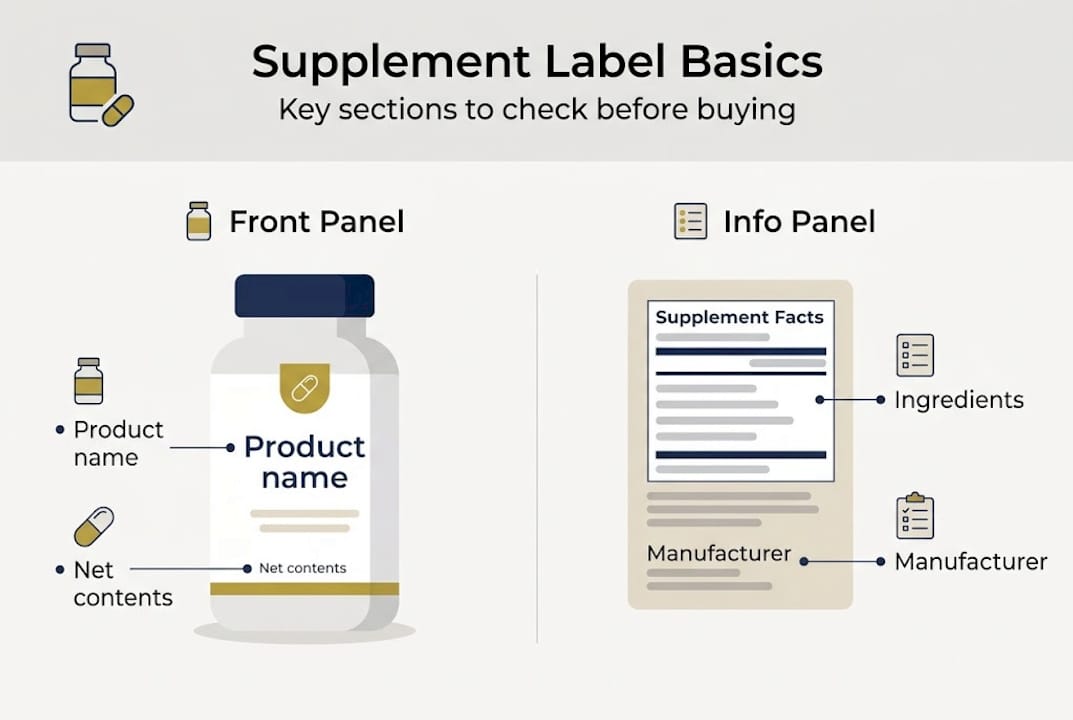
Labels are physically divided into two main areas. The Principal Display Panel and Information Panel are label sides, each serving a distinct purpose. Here’s how they break down:
| Label area | Location | What it contains |
|---|---|---|
| Principal Display Panel | Front of product | Product name, form (capsule, powder), net quantity |
| Information Panel | Side or back | Supplement Facts, ingredient list, manufacturer details |
The front panel is essentially marketing territory. It tells you what the product is and how much you’re getting. The back and sides are where the real information lives. Make it a habit to flip the product over before anything else.
Here’s a quick checklist of what to confirm before you buy:
- Statement of identity: Does it clearly name the product and its intended form?
- Net quantity: Is the amount per container clearly stated in weight or units?
- Supplement Facts panel: Is there a structured panel with serving size, servings per container, and nutrient data?
- Full ingredient list: Are all other ingredients, including fillers and binders, listed?
- Manufacturer details: Is there a name, address, and contact point?
Understanding what a clean label actually means helps here too. Products with fewer unnecessary additives and full ingredient transparency tend to score better across all five of these elements. If a brand can’t be bothered to include complete information, that tells you something about how they approach quality across the board.
How to decode the Supplement Facts panel for real insights
With the basic label sections understood, the next step is mastering the Supplement Facts panel, the heart of the information you’ll need. This is where dosage reality lives, and it’s where most buyers get tripped up.

The first thing to check is serving size. Serving size, servings per container, and %DV are the foundational data points on any Supplement Facts panel. A serving is not always one capsule. Some products require three or four capsules to constitute a single serving, which dramatically changes the cost-per-dose calculation and daily convenience.
Next, look at the Percent Daily Value (%DV). This figure tells you how much of the recommended daily intake a single serving provides. A few benchmarks worth memorising:
- 5% DV or less is considered low for that nutrient
- 20% DV or more is considered high
- Higher %DV is not automatically better; some nutrients become problematic in excess
- Many performance-focused ingredients (like creatine or beta-alanine) don’t have an established %DV at all
For fitness-specific nutrients, cross-reference dosages against evidence-backed benchmarks. The NIH nutrient RDAs provide reliable reference ranges for vitamins and minerals that you can compare directly against what’s on the label.
Statistic to know: A %DV of 100% means the serving meets the full recommended daily intake for that nutrient, but for performance athletes, optimal intake often exceeds standard RDAs.
Pro Tip: When choosing supplements for performance, always calculate the cost per effective dose rather than cost per serving. A product with a lower price tag but a smaller serving size may actually cost more per meaningful dose.
If you want to stay ahead of what’s working in sports nutrition, keeping an eye on 2026 supplement trends can help you contextualise which ingredients are gaining evidence-backed traction and which are fading out.
Mastering the ingredient list: spotting quality and hidden additives
Understanding ingredient quality is just as crucial as numbers. You need to know what’s actually in the product, not just how much of it there is.
The ingredient list includes actives, fillers, binders, and allergens in descending order by weight. That means the first ingredient listed is present in the greatest quantity. If a flashy ingredient appears near the bottom, it’s likely present in a token amount that won’t produce any meaningful effect.
Here’s what to look for and what to watch out for:
- Active ingredients first: The primary compounds driving the product’s intended effect should appear near the top
- ‘Other Ingredients’ section: This is where fillers, binders, coatings, and flavourings are listed. Some are harmless; others may cause sensitivities
- Common allergens: Soy, gluten, dairy, and tree nuts can appear here. Always check if you have dietary restrictions
- Artificial additives: Colourings, sweeteners, and preservatives are worth noting if you’re prioritising a cleaner intake
Bioavailability is a concept that separates average supplements from genuinely effective ones. It refers to how well your body can actually absorb and use an ingredient. Magnesium glycinate, for example, is far better absorbed than magnesium oxide, yet both appear on labels as simply “magnesium.” The form matters enormously.
“The difference between a supplement that works and one that doesn’t often comes down to the specific form of the ingredient, not just the ingredient itself.”
Pro Tip: When evaluating minerals, look for terms like “chelated,” “glycinate,” “citrate,” or “malate” after the mineral name. These indicate more bioavailable forms. For herbal extracts, look for “standardised to X%” which tells you the active compound concentration is consistent.
For athletes who want to go deeper on this, our guide on clean supplements for athletic performance breaks down specific ingredient forms worth prioritising. Understanding how ingredients interact is also key, and our overview of sports supplementation for recovery covers how to stack intelligently.
Going beyond the label: verifying manufacturer transparency and safety
Once you’ve mastered supplement composition and facts, the final safeguard is ensuring the manufacturer stands behind their product. The label tells you what’s in it. The manufacturer’s transparency tells you whether you can trust that information.
Labels must include manufacturer details for accountability, including the company name, physical address, and contact information. This isn’t just bureaucratic box-ticking. It means there’s a traceable entity responsible for what you’re putting into your body.
Here’s what to look for beyond the basics:
- GMP certification: Good Manufacturing Practice certification means the facility meets established quality and safety standards
- Batch numbers: These allow products to be traced back to specific production runs, which is essential for recalls or quality queries
- Third-party testing: Independent lab verification confirms that what’s on the label is actually in the product, and nothing harmful has been added
- Accessible contact information: Reputable brands make it easy to reach them. If you can’t find a phone number or email, that’s worth noting
- Unsubstantiated claims: Phrases like “clinically proven” without referenced studies, or “guaranteed results” without conditions, are marketing language, not science
Pro Tip: Before buying a new brand, search the product name alongside “third-party tested” or “certificate of analysis.” Reputable manufacturers often publish these documents directly on their website.
Understanding why supplement quality matters for athletes goes hand in hand with this verification process. And if you’re thinking about supplements as part of a longer-term health strategy, exploring the broader role of supplements in wellness will give you a useful framework for prioritisation.
Our take: why label literacy beats marketing for real fitness outcomes
Here’s something most supplement content won’t tell you: the biggest mistakes in supplement buying don’t happen because people are uninformed. They happen because the front panel is designed to be convincing. Bold fonts, vivid colours, and athlete endorsements trigger an emotional response that bypasses rational evaluation. By the time you’ve flipped the product over, you’ve already decided you want it.
Marketing hype routinely masks underdosed or poor-quality ingredients. A product can legally claim to “support muscle recovery” while containing a fraction of the evidence-backed dose. That’s not fraud. It’s just the gap between what’s permitted and what’s effective.
Our experience consistently shows that buyers who check for athlete-grade supplement quality, transparent batch information, and third-party certifications report better long-term outcomes. Not because they’re spending more, but because they’re spending smarter. Label literacy isn’t a niche skill for industry insiders. It’s the baseline competency every serious fitness enthusiast should develop before spending another penny on supplements.
Discover Elevate Supplements for verified quality and performance
If you’ve worked through this guide and you’re ready to put label literacy into practice, the next step is finding products that actually hold up to scrutiny. That’s where we come in.
At Elevate Supplements, every product features transparent labelling with clearly structured Supplement Facts panels, evidence-backed dosages, and third-party tested ingredients. Whether you’re looking to optimise fuel efficiency with our Fuel Utilisation Stack or accelerate recovery with targeted recuperation support, you’ll find products built on ingredient integrity, not marketing promises. With free UK and Ireland delivery on orders over £100 and 24/7 customer support, making the smart supplement choice has never been more straightforward.
Frequently asked questions
What are the most important sections on a supplement label?
The most important sections are the Supplement Facts panel, ingredient list, and manufacturer information because they reveal what you’re consuming and who made it. Supplement labels must include five core elements to be considered complete and compliant.
How do I know if a supplement’s % Daily Value is appropriate?
Compare the %DV on the label to the recommended daily allowances from NIH; 5% is considered low, 20% is high for most nutrients. For performance-specific ingredients, reference NIH ODS nutrient RDAs to find the ranges most relevant to your goals.
What does bioavailability mean on a supplement label?
Bioavailability refers to how effectively your body absorbs an ingredient; bioavailable forms of minerals such as chelated minerals or standardised extracts are typically absorbed far more efficiently than cheaper alternatives.
How can I verify if a supplement is safe and reliable?
Look for clear manufacturer info for accountability, including third-party testing documentation, batch numbers, and GMP certification, all of which indicate a brand committed to safety and transparency.
Recommended
- Step-by-step supplement routine for better fitness results – Elevate Supplements
- Top supplement trends in 2026: boost your fitness now – Elevate Supplements
- How to Choose Supplements for Peak Performance Results – Elevate Supplements
- Clean label supplementation: what it means and why it matters – Elevate Supplements
- 7 Tipps zur Auswahl der Top Fitnessmatten 2025 – Just Mats

